NEWS
NEWS INDUSTRY NEWS
“We can estimate the remaining useful life of those key components. And if we know that in this many hours, or in this many miles that key component is going to fail, we can light up a service lamp for our driver and let him or her know that this component may be failing so they can take appropriate measures before these failures occur,” she added.
Additional AI applications in automotive include intrusion detection and cybersecurity enhancement using machine learning. “We can identify the attacks over the Controller Area Network (CAN bus), over vehicle-to-vehicle connected systems, or vehicle-to-grid connections. If there is any failure or any attack over these networks that can be identified with supervised machine learning methods,” Tatari said.
Tatari said virtual sensors are so important in leveraging this data because of the limitations physical sensors are imposing on the system. Sometimes it is impossible to install a physical sensor in a specific system, like installing a temperature sensor in the rotary part of the motor, for example.
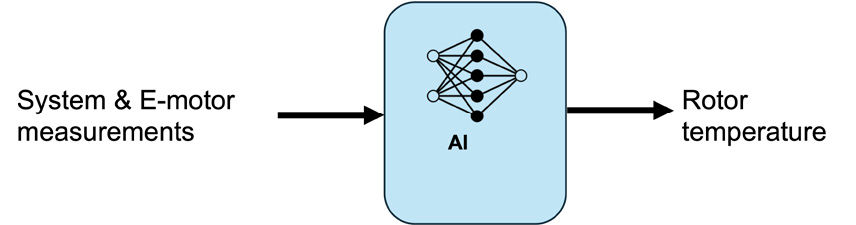
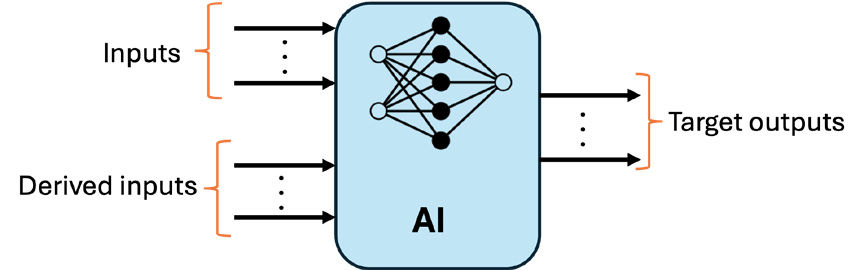
“These physical sensors degrade over time, and that can really degrade the performance of the entire system. Also, they can get noisy, they can get slow, and all in all, that can lead to inefficiencies across the entire system,” Tatari said. “Some physical sensors are unmanufacturable because they're too complex and expensive. Data-driven virtual sensors are a type of virtual sensors that can bridge the gap. We can utilize the existing data, the test data, as well as the development data to reduce some of these physical sensors in production. This reduces the cost and maintains the accuracy while increasing the reliability and efficiency of the system.”
Thermal Modeling
There are several methods for electric motor thermal modeling today including indirect methods, long-thermometer thermal networks, Kalman-based or observer-based methods, computational fluid dynamics, Finite Element Analysis (FEA) models, and data-driven or machine learning-based thermal models.
“The advantage of data-driven models is that they are very accurate because they can model the non-linearities or the higher-order terms, which cannot be captured with other methods. Data-driven thermal modeling can be executed fast for real-time temperature estimation while other methods like computational fluid dynamics or FEA cannot,” Tatari said.
The biggest advantage of data-driven thermal models is generalization. Tatari said if DSD develops a data-driven or machine learning-based thermal model for a specific motor variant, that can be generalized to another motor variant. This is something which is not always applicable for the rest of the thermal modeling methods.
There are so many advantages with machine learning-based or data-driven thermal models, but of course the trade-off is having good data—enough data—to develop these models. Sometimes it is difficult to really understand what's going on inside the model due to the way the system interprets the data.
DSD is developing a thermal model for the motor with the basic intention to guarantee the safety of the motor. Tatari said that if they have a precise estimation of the motor temperature, they can guarantee motor safety and prevent high temperatures.
“At the same time, we can be less conservative with our thermal margins, so that by knowing an accurate estimation of the motor temperature, we can have more precise thermal limits and really know exactly when to derate and when not to derate. This can lead to increasing efficiency and the performance of the motor and the system that is working with that motor,” she added.